
Prenatal Spinal Development: A Medical Astrology Assessment


At the Academy of Experimental Astrology, we place great importance on data analysis and statistical studies. Within the academy, we strive to record every event and every piece of data we encounter. Each case is examined carefully and grouped accordingly. Through this process, we are able to observe recurring patterns in astrological symbolism. Naturally, each dataset also allows us to ground astrology on an experimental basis.
Today, I wanted to share with you a piece of data that we will also preserve in our own archive. I believe this will constitute an important dataset within the field of medical astrology. On this occasion, I would like to thank my students and the academy team in advance, as their contributions enabled me to encounter yet another case.
At the center of our examination is a spinal MRI (Magnetic Resonance Imaging) of a newborn baby, which was shared with me by one of my students. The fact that the image was obtained in the sagittal plane is particularly meaningful. As you know, in medical imaging, the sagittal plane refers to side-view imaging that divides the body into right and left halves. Images may also be obtained in the coronal plane (from the front) and the transverse (axial) plane, which is horizontal; however, in this case, the image provided to me was sagittal. I would like to draw your attention to the etymology of the term.

Sagitta means “arrow” in Latin, and sagittalis means “pertaining to an arrow” or “arrow-like.” Accordingly, sagittal imaging refers to a section that cuts through the body longitudinally along the anterior–posterior axis, extending throughout the length of the body in the direction of an arrow.
Naturally, this word root also points to Sagittarius, the zodiac sign we use in astrology, symbolically represented by the figure who releases an arrow. Once again, synchronicity speaks. If you pay attention, we are currently in a period when the transiting Sun is moving through Sagittarius.
The transit at the moment of birth also corresponds to a time when multiple planets formed a stellium in Sagittarius (Mercury, Venus, the Sun, and Mars). All of this is highly meaningful…
Case Description
In this study, we will examine the birth moment of a newborn for whom both the time of birth and the time of surgery are known with precision. Our aim is to demonstrate how a congenital spinal anomaly identified at birth may be interpreted through astrological symbolism. In the case under examination, we observe that during intrauterine development, a portion of the spine did not close completely, and that the spinal cord tissue in the relevant region remained exposed outside the body.
In the clinical literature, this condition is discussed within the group of congenital anomalies associated with neural tube development.
Because such anomalies arise from the failure of the closure mechanism that should occur during the embryonic formation of the spine and spinal cord, it becomes necessary, from an astrological perspective, to also take prenatal studies into consideration.
The issue relates to the inability to preserve the structural integrity of the spinal axis and to clearly establish its boundaries. Consequently, we are faced with an axial organizational problem in which the central nervous system and the spine develop together.
The precision of the birth time allows the planetary positions during the prenatal period to be correlated with developmental timing. For this reason, our study adopts an analytical and descriptive approach, with the aim of exploring how astrological symbols may correspond with biological developmental processes.
The purpose here is not to make a medical diagnosis or to propose a causal claim, but rather to demonstrate how the symbolic language of medical astrology may help to contextualize critical thresholds in prenatal development.
Our analysis will proceed by focusing in particular on the relationship between the Gemini–Sagittarius axis and the nervous system and spinal axis, the Saturn–Neptune conjunction and the theme of structural closure, the Mars–Sun interaction in relation to vitality and differentiation processes, and the use of the nodal chart as a bodily–organic map.
Moment of Birth

In the natal chart corresponding to the moment of birth, we observe that the rising sign is Libra. In medical astrology, the 1st house and the rising sign represent the general structure of the body, physical integrity, the organism’s responses to the external world, and the vital axis. At the same time, they provide important indications regarding the themes through which the body may have been shaped at birth and which systems may be operating with greater sensitivity.
In both classical and modern medical astrology literature, Libra is associated with balance, symmetry, bilateral structure, connective tissues, the kidneys, the lumbar region, and the homeostatic balance mechanisms of the organism (Culpeper, Astrological Judgment of Diseases; Cornelius, The Moment of Astrology). A Libra rising suggests that the body structurally requires balance and that boundaries, proportions, and mutual harmony carry particular sensitivity. For this reason, we may say that themes related to axial organization and symmetrical development of the body overlap with the main axes of this study.
In the chart, the Moon is also located in the 1st house. Let us recall that in medical astrology, the Moon is associated with embryonic development, cellular proliferation, fluids, tissues, and growth processes. Especially in prenatal studies, the position of the Moon serves as an important indicator of the extent to which the organism may undergo a development that is vulnerable, permeable, or open to external influences (Ramesey, A Treatise on Medical Astrology; Saunders, Astrological Medicine). The Moon’s placement in the 1st house suggests that bodily processes are expressed more “centrally” and directly through the physical structure.
The ruler of the Ascendant, Venus, is one of the fundamental indicators used to assess the chart’s overall health potential and the body’s capacity to establish internal balance. In this case, Venus is in Sagittarius. By nature, Venus is a nocturnal planet, and in a diurnal sign it is not in its own sect. This leads us to say that Venus may have difficulty expressing its functions in a natural and harmonious flow (Firmicus Maternus, Matheseos).
In addition, Venus being combust the Sun indicates that the planet may struggle to manifest its own nature in a clear and balanced manner. From a medical astrology perspective, combustion points to themes of pressure, dryness, separation, or dissolution affecting the organs and functions represented by the planet.
Venus being positioned east of the Sun is considered in classical sources as another indicator of loss of dignity, suggesting that the planet’s balancing capacity may be further weakened (Bonatti, Liber Astronomiae). In short, we may observe that Venutian principles associated with structural integrity and connective tissues are overshadowed by a center characterized by high heat and separative force.
In medical astrology, the 6th house is associated with disease tendencies, functional disorders, bodily weaknesses, and the organism’s responses under stress. In this case, we observe a Saturn–Neptune conjunction in Pisces in the 6th house. Pisces is associated with themes of boundary dissolution, ambiguity, fluids, and permeability. The Saturn–Neptune conjunction may bring forward the theme of structural boundaries (Saturn) failing to become sufficiently defined, dissolving, or melting away (Neptune).
In the medical astrology literature, the Saturn–Neptune combination is associated particularly with closure mechanisms, boundary formation processes, and situations in which the organism struggles to clearly differentiate between “inside” and “outside” (Reinhold Ebertin, Astrological Healing). We observe a striking parallel between the symbolic language of this placement and the structural integrity issues observed in the development of the spinal axis and the central nervous system.
When we evaluate all these indicators together, we observe that themes of balance, axis, boundaries, and closure stand out prominently throughout the natal chart. One particularly notable point is the incomplete structural closure in specific segments of the spine. Please pay attention to the image.

In clinical imaging, we observe that the anomaly spans the thoracolumbar transition region, extending approximately from the T10–T11 levels to the L1–L2 segments. In this area, the vertebral arches are not fully closed, and the spinal cord tissue remains exposed outside the body at the relevant segments.
In both modern medicine and the tradition of medical astrology, functional relationships are established between specific vertebral levels and certain organs and systems within the segmental structure of the spine. Thoracic and lumbar vertebrae are accepted as being associated with the kidneys, ureters, branches of the autonomic nervous system, and reflex areas related to the pelvic region. In particular, the T10–L2 segments are defined as a region through which neural networks associated with renal functions, the urinary system, and the abdominal–pelvic transition pass (Gray’s Anatomy; Netter, Atlas of Human Anatomy).
From a medical astrology perspective, let us recall that spine–organ relationships have been approached through symbolic correspondences since early periods. In short, do not all these indicators in fact point to the symbolic domain of Libra? We know that in classical astrology, Libra is associated with the kidneys, urinary system, lumbar region, and bodily balance (Homo signorum). Therefore, together with the Ascendant and Moon being in Libra and Venus being in a weakened position, we may interpret the spine–organ–sign relationship symbolically as highlighting key regions in bodily development.
If you notice, there is an antiscia relationship between Saturn at 25°22′ Pisces and the Ascendant at 4°46′ Libra. Saturn’s contact with the Ascendant axis not through a direct aspect but through reflection indicates that a Saturnian influence permeates the body’s fundamental structural axis.
Health Almuten: Jupiter
(Within the framework of the Umar al-Tabari tradition)
I find it meaningful to include the Health Almuten approach in our evaluation. The concept of the health almuten is a holistic method used especially within the tradition of Umar al-Tabari and early Islamic astrology to determine the general ruler of health in a chart. It is an important indicator derived by calculating the degree dignities of key life significators, particularly the Ascendant, the Moon, the condition of the 6th house, the Lot of Infirmitatum (Arabic part) and its ruler, and other primary vitality indicators.
According to the calculation, the infant’s health almuten is Jupiter. This significator is located in the 10th house, at 23° Cancer, and is retrograde. While Jupiter is associated with growth, extension, and expansion, Cancer carries meanings related to the prenatal environment, the womb, and nurturing structures. For this reason, this placement may be directly related to stages of intrauterine development. Jupiter in Cancer can initially be viewed as a favorable placement in terms of exaltation; however, exaltations also express that the process of growth may proceed in an excessive or uncontrolled manner. In addition, the retrograde condition suggests that growth progresses in a redirected or altered way.
Jupiter forms trine aspects with Saturn and Neptune. Although this may appear benefic at first glance, it may also suggest that the infant’s development is open both to expansion and to dispersion, and that boundaries may not become sufficiently well defined during this process.
The almuten Jupiter also emerges as the most active planet in the chart, as it is the natural ruler of the Sagittarius stellium (Mercury, Venus, Sun, Mars). There is no direct aspectual connection between Jupiter and these planets; however, even if the degrees do not match exactly, Sagittarius as a sign is in a contra-antiscia relationship with Cancer, the sign in which Jupiter is placed. This is worth keeping in mind. For this reason, the planets within the Sagittarius stellium may play an important role in the developments occurring throughout the infant’s process.
The Gemini–Sagittarius Axis and the Nerve–Spine Relationship
In medical astrology, Gemini is associated with the peripheral nervous system, neural transmission, and reflex connections. Sagittarius, on the other hand, represents the spine itself, particularly the spinal axis and spinal cord that extend throughout the length of the body. The half-human, half-horse symbolism of Sagittarius describes an axial structure in which the upper and lower body are joined. For this reason, Sagittarius also symbolizes the principle of vertical organization extending along the cervical, thoracic, and lumbar regions of the spine.
In this case, the concentration of planets in Sagittarius indicates that the issue is not a localized bone problem, but rather a more holistic theme related to the axial development of the spine. Let us also emphasize that the prenatal Full Moon we will examine in the next section is located on the Gemini/Sagittarius axis, as this axis symbolizes the simultaneous activation of the nervous system and the spinal axis, and suggests that a critical threshold of completion has been reached during the developmental process.
Nevertheless, when considering balance, the postural dimension of the spine is associated with Venus and Libra symbolism. In this example, Venus being the ruler of both the Ascendant and the Moon indicates that the body’s general organization, balance system, and search for symmetry operate through a Venusian principle. However, the issue at hand is not a postural disorder, but a structural issue related to the failure of axial closure during the prenatal period. This distinction is important, because while Venus governs balance and alignment, it does not directly govern whether a structure is built or completed.
The unclosed structure may instead be directly related to Saturn. Bones, the skeleton, and structural form fall under Saturn’s governance. In this case, Saturn is in Pisces and conjunct Neptune; thus, we may say that Saturn’s function of “building structure” is weakened by Neptune, creating a context in which the boundaries that should protect and complete the spine fail to form adequately.
In fact, the situation here emphasizes not the absence of bones, but rather the theme of a structure that cannot be completed or preserved. Accordingly, the issue aligns with Saturn’s domain being dissolved by Neptunian influence. Still, if we pay attention, this pair is in Pisces, and once again we arrive at Jupiter, the ruler of Pisces and the health almuten of the chart.
Prenatal and Natal Charts and the Developmental Threshold
The strong emphasis on the theme of growth and expansion through Jupiter also indicates that this process is a matter of timing and thresholds. The placement of the lunar nodes on the 6th/12th house axis in the natal chart suggests that prenatal development operates within a body–function–womb triangle. While the twelfth house represents the embryonic environment, the womb, and developmental processes that are not yet visible, the sixth house is associated with how bodily functions and organic systems operate. The 6/12 axis directly points to the relationship between prenatal development and the structural organization of the body.
The position of the lunar nodes suggests that the anomaly is not a random structural defect, but rather emerged at a functional threshold within the developmental process. The South Node in the twelfth house suggests that a critical phase of development remained incomplete within a “hidden” domain, while the North Node in the sixth house suggests that the body is oriented toward compensating for this deficiency on a functional level. We should therefore remember that we are dealing with a case in which the bodily systems (particularly the nervous system and spinal axis) are observed attempting to render a not-yet-completed structure functional.

When we take the factor of the lunar nodes into consideration, the Full Moon that occurred during the prenatal period gains particular significance. The prenatal Full Moon taking place at 13° on the Gemini/Sagittarius axis, and forming a partile square aspect to the lunar nodes in the chart, points to a decisive breaking point in the developmental process. Due to the hard aspect formed with the nodes, this configuration may describe a process that was interrupted or left incomplete. Indicators operating through the Gemini–Sagittarius axis appear to have directly affected the delicate balance between the peripheral nervous system and the spinal axis.
At this point, we may establish a synastry between the prenatal chart and the natal chart. If we pay attention, the degree of Mars activated during the prenatal period is re-triggered by the natal Sun at the moment of birth (22° Sag.). Consequently, the structural intervention experienced during the prenatal process is carried into the very center of the body’s life force with birth. The Mars–Sun interaction may be considered a symbolic expression of the body’s effort to survive and reorganize itself through an axial opening.
Mars–Sun Interaction and Vitality
We should also note that during this process, Mars is Out of Bounds, meaning outside its declination limits. We are therefore dealing with an uncontrolled Mars. In addition, Mars being at 22° during the prenatal Full Moon, and the Sun reaching the same degree at the moment of birth, indicates a vital threshold. Mars is a principle that separates, cuts, and intervenes. Under normal conditions, it separates structures that are meant to be separated. However, in prenatal development, it may also leave open a structure that should otherwise close. In our case, the influence of Mars appears to have been activated in such a way that, at a stage when the spine should have closed, it instead remained open.
The Sun, on the other hand, is the central principle that holds the entire body together and organizes the life force. The Sun coinciding at birth with the prenatal Mars degree indicates that life energy is directly carried onto the very axis where this intervention occurred. This represents, in a sense, a traumatic situation, yet it also reflects the body’s effort to survive and to reorganize itself.
The Nodal Chart

The nodal chart may be evaluated in our study in relation to body regions and organs. In the derived technical chart obtained by placing the South Node in the 1st house, the issue is directly associated with the body itself.
From a medical perspective, the following overall picture emerges:
The issue is located in the 4th house, that is, in the central line of the chest and spine. As the 4th house also represents the prenatal environment and the womb, it is clear that the development took shape in the intrauterine period.
Mercury in the 3rd house brings the peripheral nervous system and neural transmission into the process.
The Moon in the 2nd house emphasizes tissue development and nourishment.
The area of intervention and crisis operates through the 7th and 8th houses, pointing briefly to externally applied medical interventions and surgical processes.
Jupiter in the 11th house may indicate a supportive potential for long-term healing and adaptation.
Surgical Indicators
The newborn baby underwent surgery one day later, and the surgical intervention was carried out successfully. Let us examine together the role of the indicators in the infant’s recovery to a healthy condition following the operation. The fact that the timing of the surgery is precisely known shows that we have the opportunity, from a medical astrology perspective, to examine the symbolic language of the moment of intervention. Nevertheless, due to data privacy considerations, I will not share the exact time as direct information.
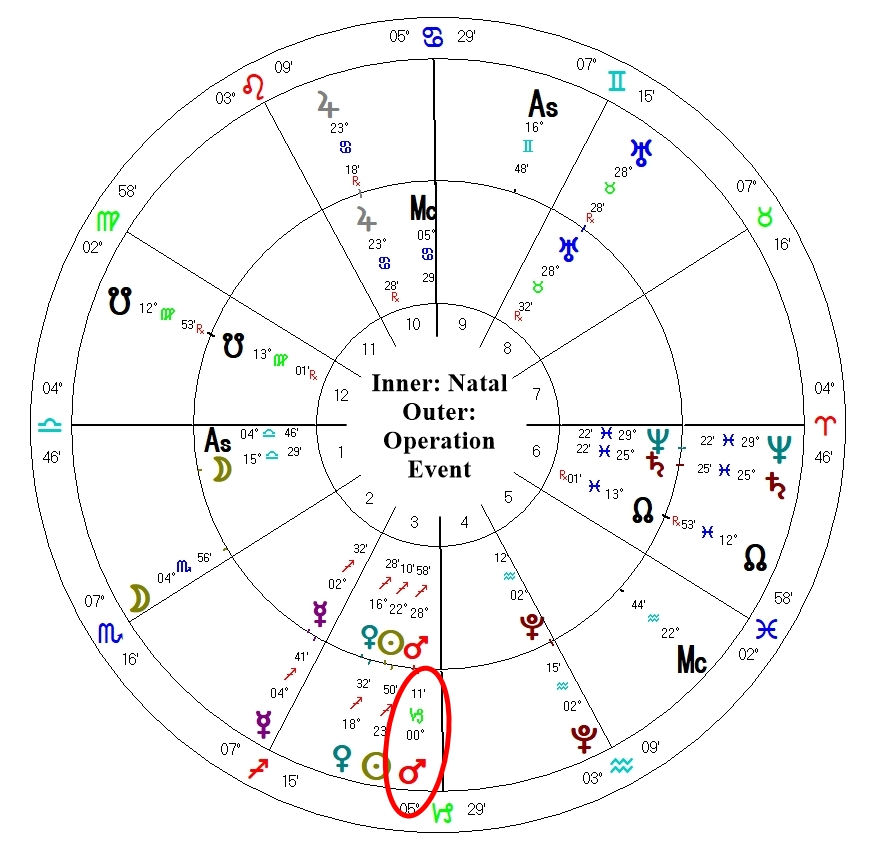
First, we observe that at the moment of surgery Mars had just entered 0° Capricorn. Mars being at the exact moment of a sign change is a condition that is handled with particular care in medical astrology. Mars represents surgical intervention, incision, the surgeon’s scalpel, and operative will. By entering Capricorn, Mars gains dignity through exaltation rulership. In other words, the nature of Mars operates in a more controlled, disciplined, and structurally constructive manner.
At the time of surgery, the Moon is placed in Scorpio, which is classically considered a debility; however, within the context of medical astrology, this placement is not always interpreted negatively. Scorpio is associated with deep tissues, hidden areas, crises, and processes of transformation. For this reason, it may suggest that the organism is undergoing a moment of crisis while simultaneously being open to deep intervention and transformation. Here, I find it more meaningful to read the Moon as the bodily process itself and as the body’s response to the intervention. Ultimately, we may also say that the Moon gains dignity in Scorpio through triplicity rulership.
At the moment of surgery, the ASC is at 16° Gemini, forming an exact opposition to the infant’s natal Venus at 16° Sagittarius. In other words, the DSC degree at the time of surgery is conjunct the infant’s natal Venus. In medical astrology, the Descendant represents the physician, the surgeon, the person to whom the body is entrusted, and external intervention. For this reason, the alignment of the Descendant with natal Venus clearly indicates that the principles of balance, repair, and harmony enter into action through “the other,” that is, through medical intervention.
In the surgical transit chart, Mars is located in the 8th house, which is briefly associated with surgical procedures, external interventions, and bodily crises. What may appear malefic in symbolism is, in fact, operating as a force of restoring life and regaining health. Is that not remarkable?
If we return to the natal chart at this point, we see that the natal 8th house is in Taurus, and its ruler is again Venus. Taurus is associated in medical astrology with bodily structure, tissue integrity, and somatic resilience. The exaltation ruler of Taurus is the Moon, and the Moon’s placement in Scorpio at the time of surgery activates the exaltation, detriment axis. This configuration does not so much point to harm as to harm being employed for benefit. It presents a symbolic framework suggesting that a crisis and intervention process is necessary in order for bodily integrity to be re-established.
When I evaluate all these indicators together, I can clearly say that the timing of the surgery presents a pattern suggesting that the intervention was symbolically carried out “from the right place and with the right instrument,” supported by Mars gaining dignity, the Descendant aligning with natal Venus, the Moon being in a deep and intervention-responsive sign, and the strong emphasis on the 8th house.
I would like to remind the reader that the aim here is not to explain why the surgical outcome occurred astrologically, but rather to show how the symbolic language of the moment of intervention resonates coherently with the themes observed in the natal chart. Our evaluations provide an analytical example of how astrological symbols may establish meaningful parallels with biological developmental processes.
Thank you,
Kenan Yasin Bölükbaşı
16.12.2025, 16:24, Aydos / Istanbul
REFERENCES
Brady, B. (1999). Predictive astrology: The eagle and the lark. Weiser Books.
Culpeper, N. Astrological judgement of diseases. (Original work published 17th century)
George, D. (2019). Ancient astrology in theory and practice: A manual of traditional techniques (Vol. 1). Demetra George.
Hill, J. (1992). Medical Astrology: A guide to planetary pathology. The Aquarian Press.
Lilly, W. (n.d.). Christian Astrology. (Original work published 1647)
Manilius. (n.d.). Astronomica. (Original work published 1st century CE)
Nauman, E. (1991). Medical Astrology. American Federation of Astrologers.
Ptolemy, C. Tetrabiblos. (Original work published 2nd century CE)
Ridder-Patrick, J. (2010). A handbook of medical astrology. Open University Press.
Rudhyar, D. (1978). The lunation cycle. Shambhala Publications.
Schulman, M. (1977). Karmic astrology: The moon’s nodes and reincarnation. Weiser Books.


Comments